 SmileProgress
An iOS app that aligns and anonymises orthodontic photos on-device for personal logging. Optional anonymous Before / After sharing, browsable on a web gallery.
SmileProgress
Overview
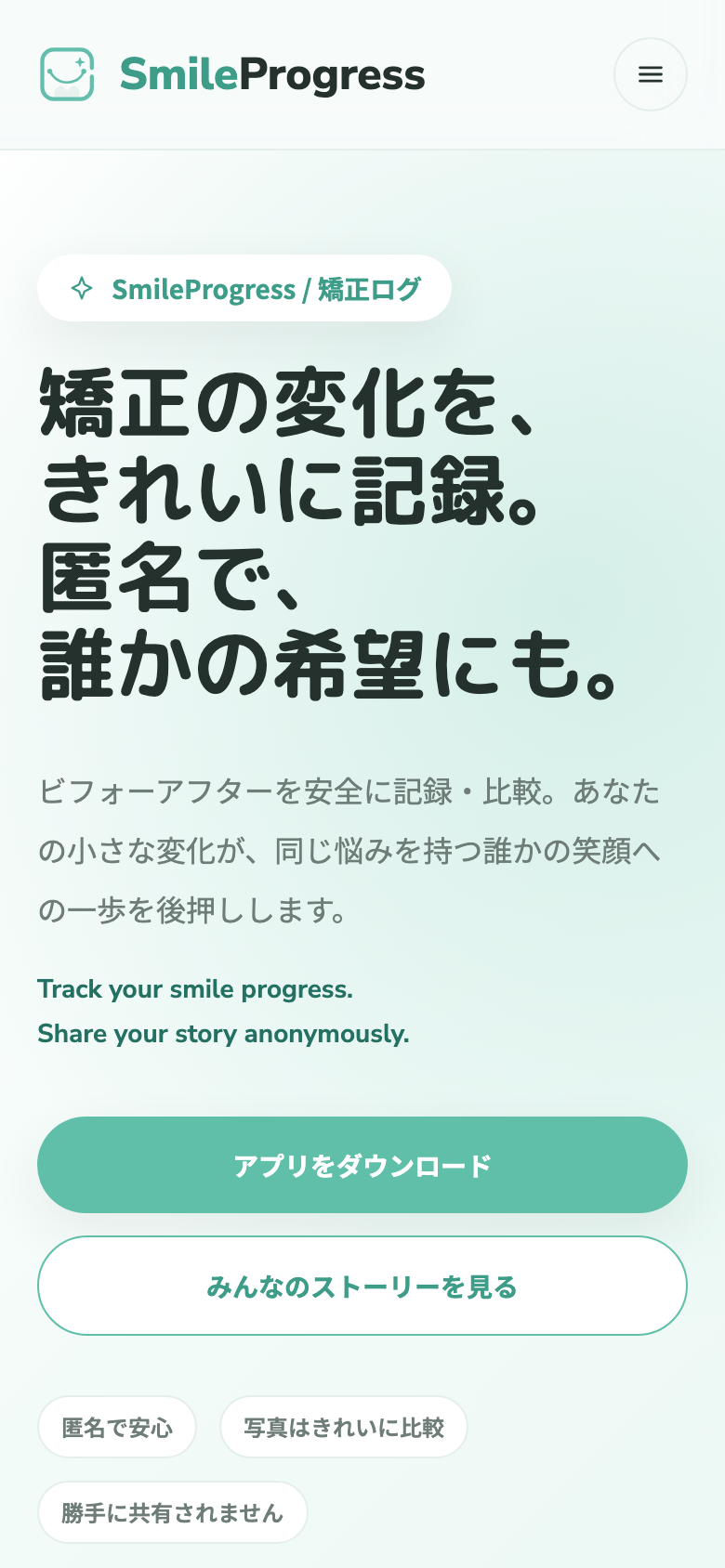
SmileProgress ("矯正ログ" in Japan) is an iOS app for logging orthodontic progress, paired with a web gallery of anonymous stories. Photo alignment and anonymisation run fully on-device; sharing is opt-in with explicit scope choices — anonymous public or link-only. Released on the App Store in July 2026.
The problem
Progress photos matter to the person going through treatment, yet posting them straight to social media risks identification and misunderstanding of clinical context. At the same time, others on the same journey genuinely want to see real Before / After cases — a safer way to bridge the two needs.
Key features
- On-device alignment and anonymisation — nothing leaves the phone
- CoreML mouth detection auto-aligns Before / After photos
- Four comparison layouts — slider, side-by-side, stacked, timelapse
- Explicit scope selection plus a "this image will be published" confirmation
- Filter shared stories by country, duration, and treatment type on the web gallery
Tech stack
Architecture
The iOS app is built with SwiftUI; an AVFoundation capture guide and CoreML (face-parsing BiSeNet) + Vision mouth detection align photos via similarity transforms. The backend runs on API Gateway + Lambda (Node.js 20) + DynamoDB + S3 + CloudFront, with types generated from an OpenAPI 3.1 contract. The web gallery is statically generated with Next.js 16 and rebuilt via GitHub Actions on new posts. Infrastructure is five AWS CDK stacks.
AI's role and boundaries
AI does one thing here: on-device mouth detection, used only to align photos and assist anonymisation. It never judges alignment quality or how treatment is progressing. In a domain this close to medicine, that decision is not delegated to a machine by design. Remove the detection, and recording and comparison still work manually. What is lost is only the convenience of automatic alignment. On the production side, AI helps with copywriting, guide drafts, and translation.
Evaluation & Operations
Released on the App Store on 2026-07-04. Operated on a three-tier model — free, one-time purchase, Pro. The public gallery relies on two moderation layers (metadata rules + image moderation) plus a report flow. App Store reviews and usage data drive ongoing checks on scope clarity and anonymity.