


 MiraProof
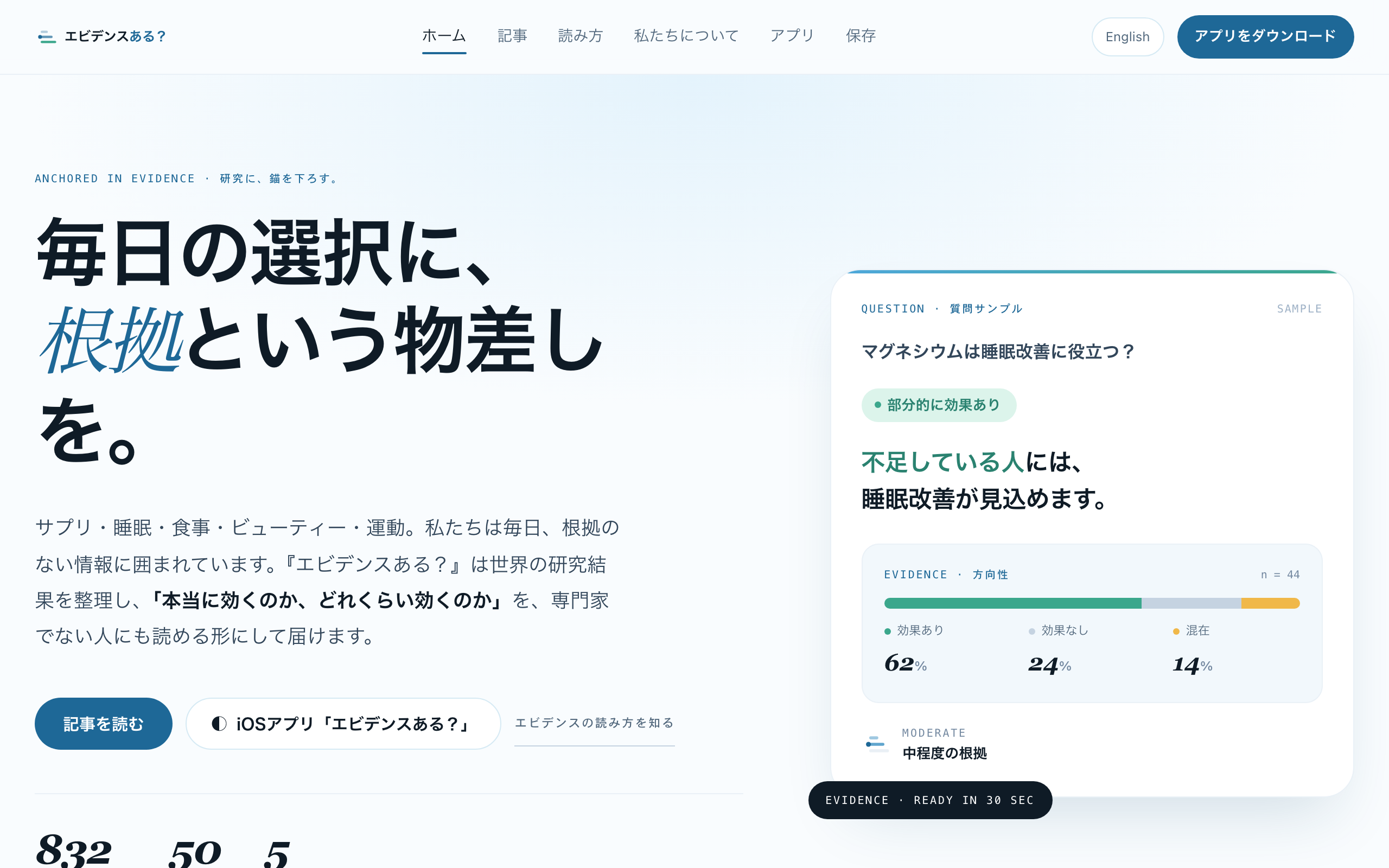
A web service that answers everyday questions about supplements, sleep, food, beauty, and exercise with structured, research-grounded summaries and articles. It ships as "エビデンスある?" in Japanese.
MiraProof
Overview
MiraProof ("エビデンスある?" in Japan) covers five areas — supplements, sleep, food, beauty, and exercise — with structured, research-grounded answers and explanatory articles. Questions are classified and normalised, primary sources are gathered from PubMed, Europe PMC, and OpenAlex, and the answer states both the direction of the effect and how strong the evidence is. The bilingual web product launched at miraproof.com on 2026-07-02. The SwiftUI iOS app already runs against the production API and is being prepared for App Store submission.
The problem
Advice about supplements and sleep is buried under confident marketing and personal anecdotes. The research often has an answer, but the primary sources are in English and take time to read. At the same time, a wrong assertion in this domain can cause real harm, so handing the writing straight to a generative model is not an option either.
Key features
- Classifies each question by domain, population, intent, and risk, and declines anything outside the covered areas
- Builds citations only from primary sources on PubMed, Europe PMC, and OpenAlex, excluding non-human and retracted studies
- Presents a structured answer stating the direction of the effect and the strength of the evidence
- Reuses previous answers for similar questions via S3 Vectors similarity search, cutting latency and generation cost
- Generates articles as ja / en pairs, with publishing decided by an automated review
Tech stack
Architecture
The web app is a static Next.js 15 App Router export served from S3 + CloudFront, with /ja/ and /en/ as canonical URLs. The Python backend runs classification, normalisation, evidence retrieval, synthesis, confidence scoring, and the publish gate as a pipeline on AWS AgentCore Runtime. Storage is DynamoDB and S3, with S3 Vectors backing answer reuse. The iOS app is SwiftUI (iOS 18+), authenticating via an anonymous device ID plus Sign in with Apple, with push delivered through SNS to APNs. Infrastructure is seven AWS CDK (Python) stacks, deployed by GitHub Actions over OIDC.
AI's role and boundaries
Models are split by role on Amazon Bedrock: Amazon Nova 2 Lite for classification and extraction, Claude Sonnet 4.6 for generating the bilingual structured answers. Risk is gated by a dictionary first, so the LLM only decides domain, population, and intent, and writes the prose. Article review runs through two reviewers — Claude Opus and Codex — and an article publishes automatically only when they agree. A person steps in only to take something down after publication, and without inference no article exists at all, so the product is built on AI by design.
Evaluation & Operations
The web product is live, serving 50 bilingual seed articles plus explainers as static pages. The backend is guarded by a golden-set evaluation and pytest. Article quality has been hardened through adversarial review on three fronts — citations, study counts, and confidence. Two operating constraints stay fixed: never assert an effect outright, and never answer questions about diagnosis or treatment.