


 Eratsuku
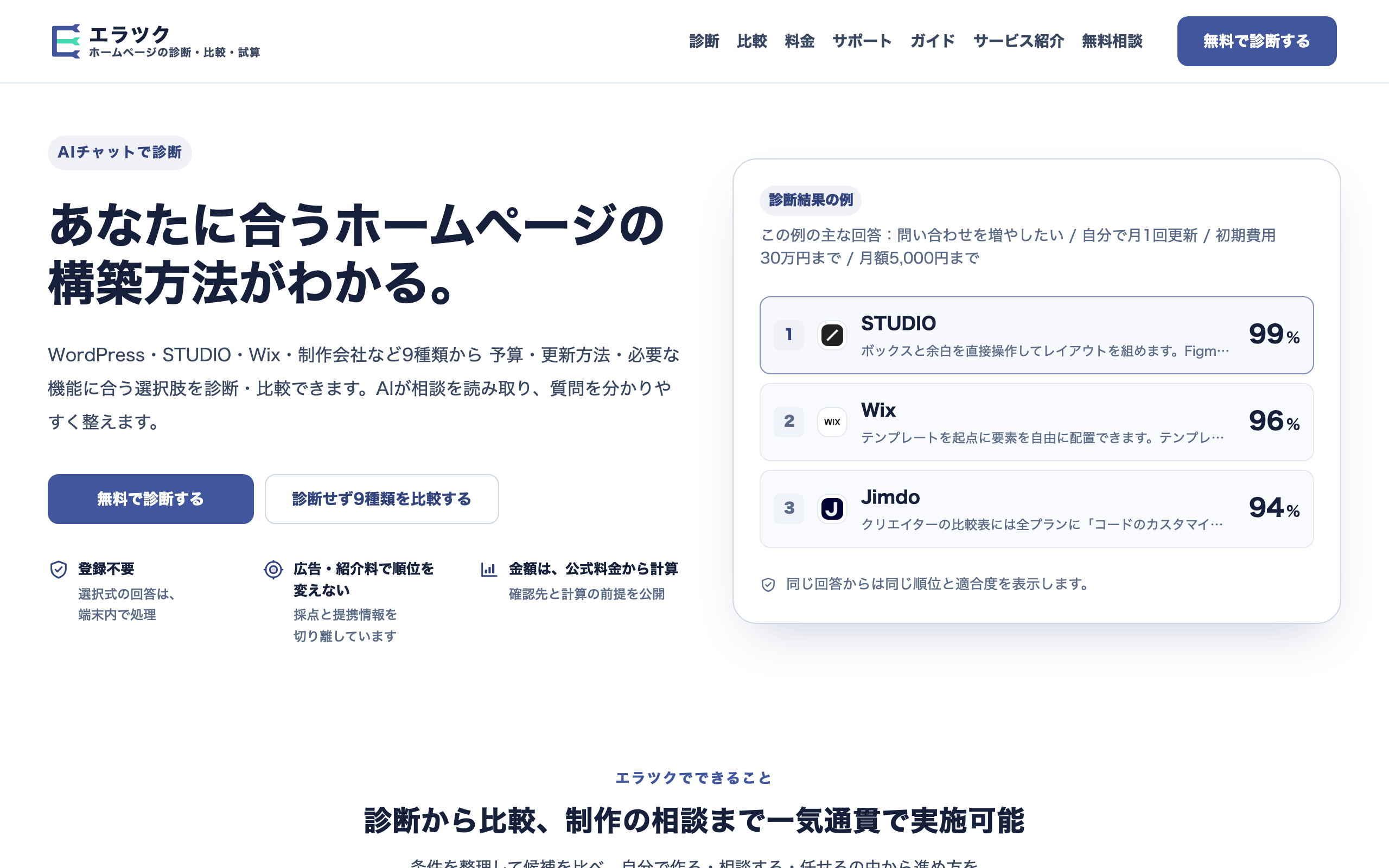
A diagnosis and comparison site for choosing how to build a website before building it. Nine approaches are scored on the same axes, and every price shown is checked against the text of the vendor's own pricing page.
Development started on 2026-07-31 and the site went live on 2026-08-10. It runs in Japanese only.
Eratsuku
Overview
Eratsuku helps you decide how to build a website before you start. Answer nine questions and it scores nine approaches — WordPress, no-code builders, e-commerce platforms, custom development, and hiring an agency — on the same axes, then shows the fit, the reasoning behind it, the likely cost, and what to do next. It also has a consult mode where writing a one- or two-line concept starts an AI-driven conversation that reads out the same conditions. It is written for small businesses, shops, professional practices, and sole proprietors, on the assumption that the reader is not a web specialist. Alongside the diagnosis it carries 16 vendor review articles and 9 guide articles on choosing, cost, and operating a site. Development started on 2026-07-31 and the site went live on 2026-08-10.
The problem
Comparisons of website-building options tend to be either vendor marketing or generic advice with the conditions stripped out. Prices circulate as ballpark figures with no source, so the assumptions only surface after the contract is signed. Even services that call themselves diagnostics can return different results for the same answers, and give the user no way to check whether affiliates are being pushed to the top.
Key features
- Nine questions, scoring nine approaches across seven axes: purpose, budget, features, update frequency, who updates, maintenance, and launch timing
- Ranking and fit are computed deterministically — no randomness, no current time — so the same answers always give the same result
- Affiliate data is isolated from the scoring code, and a test checks that the scoring side never imports it
- Every price is a quotation from a saved copy of the vendor's own pricing page; the check fails if that exact string isn't there
- Approaches that cannot meet a stated condition are kept out of the top spots, with the unmet condition shown as the reason
- For approaches with no published pricing, no ballpark figure is invented — it is shown as requiring a quote
- A pricing simulator that switches between setup cost, monthly cost, and 1 / 3 / 5-year totals
- Answering the nine questions runs entirely in the browser on the same deterministic scoring, with nothing sent to a server
- A consult mode where writing a one- or two-line concept starts a conversation driven by Amazon Bedrock (Nova 2 Lite). AI only reads what's written and writes the follow-up questions; the ranking, fit, and cost are computed by the same deterministic scoring used in the eight-question flow
Tech stack
Architecture
A static Next.js 16 App Router export served from S3 + CloudFront. The nine-question scoring runs entirely in the browser, with answers never reaching a server. There are two exceptions: the enquiry form posts to a separate Lambda Function URL and arrives by SES, and the consult mode calls another Lambda Function URL that invokes Amazon Bedrock (Nova 2 Lite) — only to read what's written and write the follow-up questions. The scoring logic and the build-method data depend on neither React nor Next.js, so tests read them straight from Node. CSP and security headers live in a single JSON file that both the CDK stack and the local strict server read, so the two cannot drift. Infrastructure is five AWS CDK stacks — DNS, site, consult, CI/CD, and form — and the domain eratsuku.jp stays with Sakura Internet, pointing its DNS at CloudFront.
AI's role and boundaries
The brand doesn't just carry "AI" in its name — the consult mode actually calls Amazon Bedrock (Nova 2 Lite). The LLM only ever reads the words in the concept and the answers. What to ask next, when to end the conversation, and the ranking, fit, and cost are all computed by the same deterministic scoring used in the nine-question flow, and the server discards any LLM output that contains a price or a vendor name. If the call fails, the conversation falls back to a fixed phrasing per industry instead of stopping. The nine-question flow works the same with or without the consult mode, so removing AI leaves the ranking unchanged. AI is also used on the production side — implementation, article structure, and review. Quality rests on 28 unit tests over the scoring logic and a string-for-string match of every published price against the saved vendor page.
Evaluation & Operations
The site just launched, so there is no traffic data yet. The bar is that no one signs a contract based on a wrong number. Every published price is matched string-for-string against the saved vendor page, and the check fails on any mismatch. Some vendors render prices in JavaScript, so the pages are captured with Playwright rather than fetched raw. The scoring logic has 28 unit tests, and seven gates run before every push: types, lint, source matching, text contrast, unit tests, build, and browser checks. After launch, "the deploy succeeded" and "the fix is live" are verified separately, by checking every sitemap URL and the security headers against production.